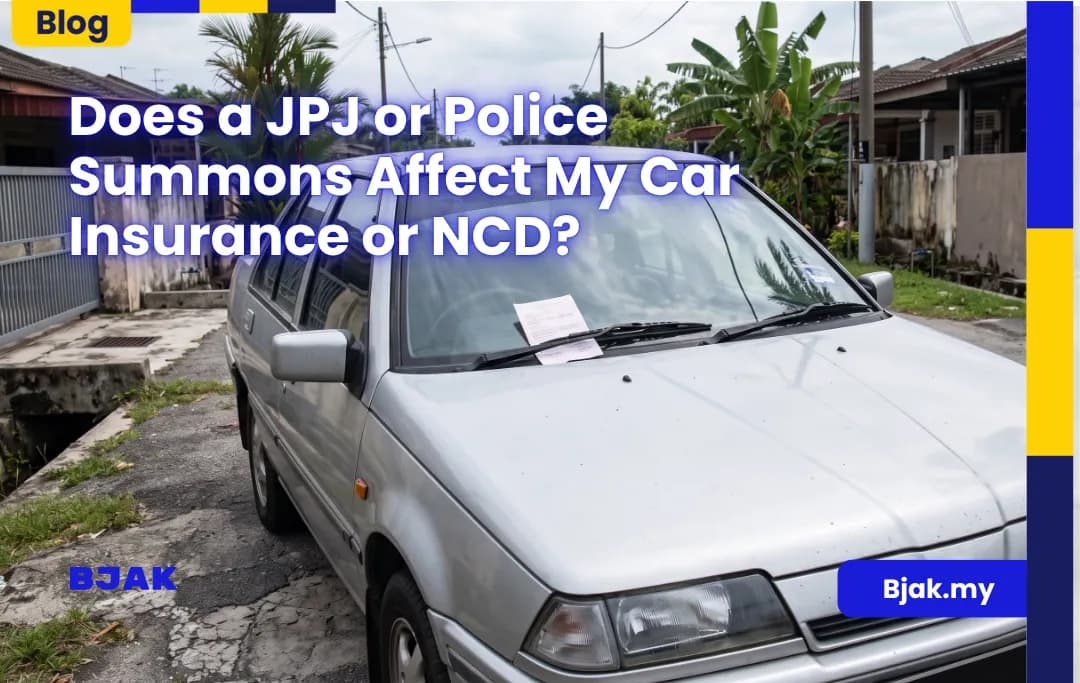
Receiving a traffic summons from the Road Transport Department (JPJ) or the Royal Malaysia Police (PDRM) may leave you wondering whether your car insurance price will increase or your No Claim Discount (NCD) will be affected.
Generally, a traffic summons does not automatically cause you to lose your NCD or pay more for car insurance. NCD is usually affected by certain insurance claims, while the impact of a summons depends on the offence and the circumstances involved.
Does a Traffic Summons Affect Your NCD?
NCD is a discount for policyholders who maintain a qualifying claims-free record. For private cars in Malaysia, the discount can increase to 55% after five claim-free years.
Receiving a speeding ticket or another traffic summons does not automatically reduce your NCD. However, if the offence leads to an accident and you make an own-damage claim that affects your NCD, your discount may reset to 0% at renewal.
Read our car insurance learning hub to learn more about how NCD works and what may affect your discount.
Traffic Summons vs Insurance Claims: What’s the Difference?
Situation
Possible effect on insurance or NCD
Receiving a speeding summons
Does not automatically affect NCD
Receiving a parking or traffic offence summons
Generally does not directly change NCD
Having an accident and making an own-damage claim
NCD may reset to 0%, depending on the claim
Claiming against the at-fault driver’s insurance
Generally does not affect your NCD
Making an eligible Own Damage Knock-for-Knock (OD-KFK) claim when you are not at fault
NCD generally remains unaffected if the conditions are met
Driving under the influence of alcohol or drugs during an accident
A claim may be rejected under applicable policy terms and laws
Note: The actual outcome depends on your coverage, how the claim is handled and your policy terms.
Can a JPJ or Police Summons Increase Your Car Insurance Price?
An unpaid summons does not necessarily increase your car insurance price automatically. Insurers generally consider factors such as your vehicle model, sum insured, NCD, coverage type and their assessment of risk.
However, serious offences or certain circumstances involving a breach of the law may affect coverage or claim eligibility. For example, driving under the influence of alcohol or drugs may result in a rejected claim under the applicable policy terms.
If you receive a summons from JPJ or PDRM, check the offence details and the action required.
Check the summons. Confirm that the registration number, date and offence details are correct.
Resolve it according to the instructions. Check the official channels for payment or further action.
Check your blacklist status if necessary. Unresolved summonses or notices may be referred to court and can lead to blacklisting in certain circumstances.
Review your policy after an accident. If the summons relates to an accident, contact your insurer to understand the claims process and whether your NCD may be affected.
A JPJ or police summons does not automatically mean you will lose your NCD or pay more for car insurance. What matters most is the offence, the circumstances of any accident and whether an insurance claim is made.
Before renewing your policy, check your current NCD and compare available coverage options to find car insurance that suits your needs and budget.
Not automatically. NCD is generally affected by certain insurance claims, rather than simply receiving a summons.
If I pay the summons, will my NCD remain unchanged?
Paying a summons does not determine your NCD status. Your discount depends on your insurance claims record and policy conditions.
Will my NCD be affected if I am not at fault in an accident?
Your NCD generally remains unaffected when an eligible third-party or OD-KFK claim is handled according to the applicable conditions. Check with your insurer to confirm your eligibility.
How can I avoid losing my NCD?
Drive carefully and understand your claims options before deciding how to proceed. Where eligible, claiming against the at-fault party may help preserve your NCD. You can also check whether an NCD Relief or NCD Protector add-on is available under your policy.

 Nabil Farhan· · 3 min read