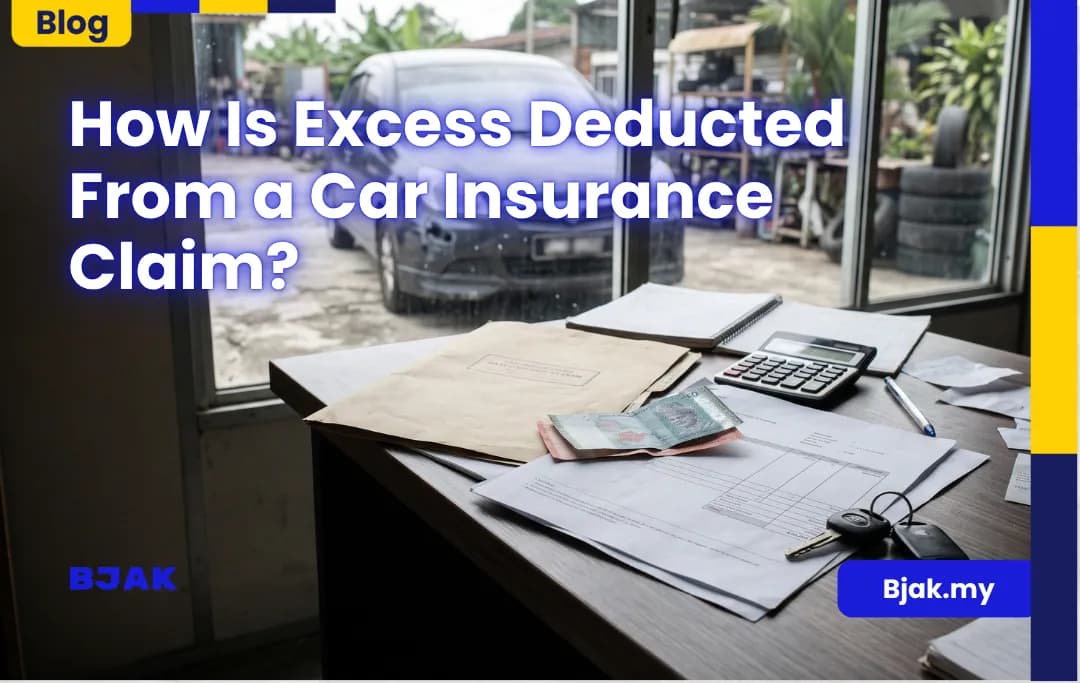
After a car accident, your insurance claim may be approved, but you might not receive the full repair amount. This is because an excess may be deducted from the approved claim.
Excess is the portion of a claim that you must pay yourself under your car insurance policy. The amount depends on your policy terms and the circumstances of the accident.
Here is how excess affects your car insurance payout, with simple examples to help you understand the calculation.
How Does Excess Affect Your Insurance Claim Payout?
When your insurer approves a claim, the excess is deducted from the amount payable or collected from you as your share of the repair cost.
For example, if your insurer approves RM5,000 in repair costs and your applicable excess is RM400:
Description
Amount
Approved claim amount
RM5,000
Excess you must pay
RM400
Amount covered by insurer
RM4,600
In this example, you are responsible for RM400, while the insurer covers the remaining RM4,600.
The calculation is based on the approved claim amount, not necessarily the workshop’s initial repair quotation. Your insurer may assess the damage and approve a different amount. you can learn on how to make a car insurance claim.
What Types of Excess Can Be Deducted?
The amount you need to pay may include more than one type of excess, depending on your policy.
Standard or Policy Excess
This is the excess stated in your policy schedule. It is the amount you agree to bear when making a claim that is subject to excess.
For example, if your policy schedule states an excess of RM300, you may need to pay that amount for an eligible claim.
However, excess does not apply to every type of claim. Some policies treat fire, theft and third-party liability claims differently. Always check your policy wording.
Compulsory Excess
Compulsory excess is an additional amount that may apply when certain driver conditions are met.
Under many Malaysian private car policies, an additional RM400 may apply if the person driving the car with your permission:
Is under 21 years old.
Holds a Provisional (P) or Learner (L) driving licence.
Is not named in the policy schedule as a named driver.
Voluntary excess is an additional amount you agree to bear when buying your policy.
In return, the insurer may offer a lower insurance price. However, if you make a claim that is subject to excess, you will need to pay this amount as well.
For example, if your policy has a RM300 excess and you have agreed to a RM200 voluntary excess, your total excess would be RM500 before any additional compulsory excess applies.
How Is Excess Calculated When More Than One Type Applies?
If your claim is subject to more than one type of excess, the applicable amounts may be added together.
Let’s look at an example.
Suppose your car is involved in an accident while being driven by a person who is not named in your policy. Your policy has:
Policy excess: RM300
Voluntary excess: RM200
Compulsory excess: RM400
Your insurer approves RM8,000 for the repair.
Description
Amount
Approved claim amount
RM8,000
Policy excess
RM300
Voluntary excess
RM200
Compulsory excess
RM400
Total excess
RM900
Amount covered by insurer
RM7,100
In this example, you bear RM900, while the insurer covers RM7,100.
This is an illustration only. Check your policy schedule to confirm which excess amounts apply and whether they are cumulative.
Does Excess Apply If the Accident Was Not My Fault?
Not necessarily. Whether excess applies depends on how you make the claim and the terms of your policy.
If another driver caused the accident, you may be able to claim against that driver’s insurer through a third-party claim.
If you have comprehensive insurance, you may also be eligible for an Own Damage Knock-for-Knock (OD-KFK) claim through your own insurer.
Under an eligible OD-KFK claim, your No Claim Discount (NCD) is generally protected. You may also be able to recover the excess you paid from the other driver’s insurer, subject to the applicable conditions.
Before proceeding, ask your insurer whether OD-KFK is suitable for your case and whether you need to pay any excess upfront. you also need to know the difference between own camage and third-party claim.
Are Excess and Other Claim Deductions the Same?
No. Excess is only one factor that may affect your final claim settlement.
Other deductions or contributions may apply depending on your policy and the vehicle’s condition.
Item
What it means
Excess
The amount you must bear under your policy when an applicable claim is made.
Betterment
A contribution towards the cost of new original parts when they improve the condition of an older car.
Underinsurance
A reduction in the amount payable if your car is insured for significantly less than its market value, subject to the policy’s average clause.
Policy limit
The maximum amount your insurer will pay under the applicable coverage.
For example, if your car is more than five years old, betterment may apply when new original parts are used for repairs. This is separate from excess.
Therefore, do not assume that every amount you are asked to pay after an accident is an excess charge. Ask your insurer or workshop for a breakdown.
How Can I Check How Much Excess I Need to Pay?
Before accepting a claim settlement or collecting your repaired car, check the following:
Check your policy schedule
Look for the excess amount stated in your policy schedule. Also check whether you selected a voluntary excess.
Confirm who was driving
If someone else was driving your car, check whether they were named in the policy and whether any compulsory excess applies.
Ask for a claim breakdown
Request a breakdown showing the approved repair cost, excess, betterment and any other deductions.
Confirm how payment is collected
Depending on the claim arrangement, you may need to pay the excess directly to the workshop, or it may be deducted from the settlement amount.
If you are unsure about a deduction, ask your insurer to explain the calculation before making payment.
Understand Your Coverage Before Making a Claim
Excess can reduce the amount your insurer pays towards an approved claim. Therefore, it is important to understand your policy excess, compulsory excess and any voluntary excess before an accident happens.
When comparing car insurance, do not look at the price alone. Check the coverage, excess conditions and other policy benefits so you know what you may need to pay when making a claim.
Is excess deducted from every car insurance claim?
No. Excess depends on the type of claim and your policy terms. Some policies do not apply excess to certain fire, theft or third-party liability claims.
Do I have to pay excess if another driver caused the accident?
Not necessarily. If you qualify for a third-party claim or OD-KFK claim, the excess may be treated differently. Check with your insurer before choosing the claim route.
Can compulsory and voluntary excess be charged together?
Yes, they may be added together when both apply. The exact calculation depends on your policy schedule and wording.
Does excess reduce my No Claim Discount (NCD)?
Excess itself does not determine your NCD. The effect on your NCD depends on the type of claim and applicable rules. An eligible OD-KFK claim generally protects your NCD.
Can I get my excess back after making a claim?
In some cases, yes. For example, if you make an eligible OD-KFK claim because another insured driver was at fault, you may be able to recover the excess from the other driver’s insurer. This is subject to the claim circumstances and recovery process.
Where can I find my excess amount?
Check your policy schedule, Product Disclosure Sheet (PDS) and policy wording. You can also contact your insurer or takaful operator to confirm the amount applicable to your claim.

 Nabil Farhan· · 6 min read