You turn the key, the dashboard flickers and the engine only clicks. It always seems to happen just before work or halfway through a road trip. In most cases the cause is a flat battery, and a jump-start can get you moving again if you do it correctly.
This guide explains why cars need a jump-start, what you need, the exact order for connecting the cables, the mistakes to avoid and when it is smarter to call for help.
Why Does a Car Need a Jump-Start?
The most common reason is a flat battery. The battery no longer has enough charge to turn the starter motor, so the engine will not crank. A few habits and conditions usually lead to this:
Leaving the headlights, cabin lights or other electronics on while the engine is off.
An old battery that can no longer hold a full charge.
Short trips only, which do not give the alternator enough time to recharge the battery.
A car left parked and unused for a long period.
A jump-start borrows power from another car’s healthy battery to start your engine. Once the engine runs, your own alternator takes over and begins recharging the battery.
What You Need Before You Start
A set of jumper cables, usually one red (positive) and one black (negative).
Another car with a charged battery of the same voltage (most passenger cars use 12V).
Thick gloves and, ideally, eye protection.
A wire brush to clean corroded battery terminals.
Your car’s owner’s manual, because some models have specific jump-start points.
How to Jump-Start a Car: Step by Step
1. Position the two cars
Park the working car close enough for the cables to reach, but make sure the two cars do not touch. Switch off both engines, apply the handbrake and turn off the air conditioner, radio and lights.
2. Connect the cables in the right order
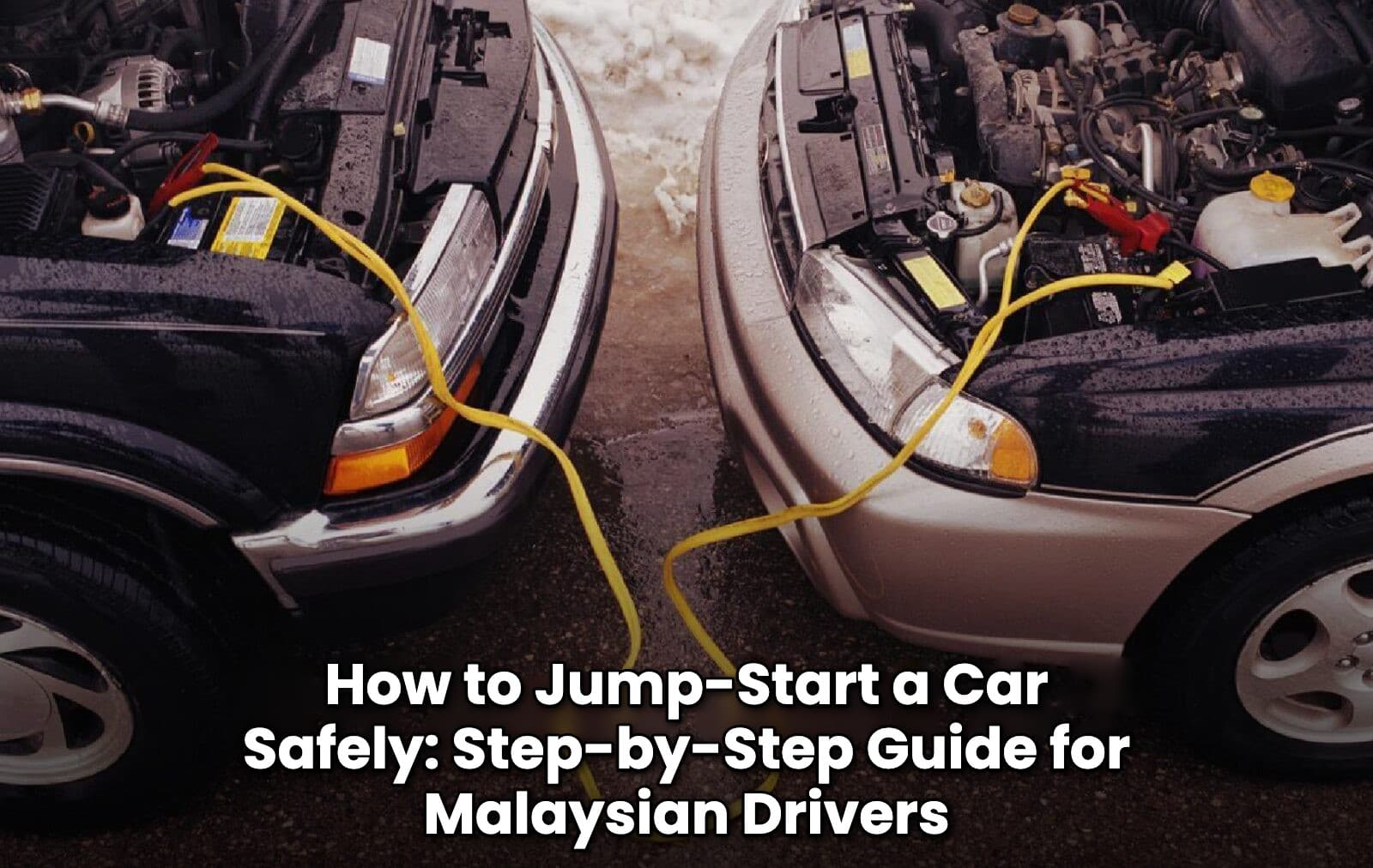
Check that both batteries are 12V and that neither is cracked or leaking. Then connect the clamps in this order:
Red clamp to the positive (+) terminal of the flat battery.
The other red clamp to the positive (+) terminal of the good battery.
Black clamp to the negative (-) terminal of the good battery.
The other black clamp to an unpainted metal part of the flat car’s engine, such as a bolt on the engine block, away from the battery and fuel lines.
Keep the clamps from touching each other or any moving engine part. Notice that the last clamp does not go on the flat battery’s negative terminal. A battery can release flammable gas, and the final connection can spark. Grounding it on bare metal keeps that spark away from the battery. Both Motorist.my and Bateriku advise this.
3. Start the working car first
Start the donor car and let it run for a few minutes. Motorist.my suggests two to five minutes. Then try to start the flat car.
4. Keep the engine running
Once the engine starts, leave both cars running for a short while. Motorist.my suggests around 15 to 20 minutes of running or driving after a successful jump-start so the alternator can put some charge back into the battery.
5. Remove the cables in reverse order
Remove the cables in the opposite order: the black clamp from the bare metal first, then the black clamp from the good battery, then the red clamp from the good battery and finally the red clamp from the formerly flat battery. Never let the clamps touch each other while any end is still connected.
6. Try the engine again
Switch the engine off and start it again to confirm the battery now holds enough charge. If it fails, do not keep retrying. Two failed attempts are a good point to stop, because repeated cranking can strain the starter motor and drain the donor car’s battery.
What Not to Do When Jump-Starting
Mistake
Why it is dangerous
Smoking or using a naked flame nearby
Battery gas is flammable and a spark can ignite it.
Letting cable clamps touch each other
It causes a short circuit, sparks and possible damage to the electronics.
Connecting the last black clamp to the flat battery’s negative terminal
It puts the final spark right next to the battery gas.
Leaving cables dangling
Live cables can touch the ground, wet surfaces or moving parts.
Skipping gloves and eye protection
Battery acid can burn skin and injure eyes.
Jump-starting a damaged battery
A cracked, leaking or swollen battery, or one that smells like rotten eggs, should be handled by professionals.
When to Call for Help Instead
A jump-start is not always the answer. Call roadside assistance or a mechanic if:
You do not have cables, a second car or the confidence to do it safely.
The battery looks damaged or leaks.
The car still will not start after two attempts, which can point to a faulty starter, alternator or a battery that has reached the end of its life.
The car starts but stalls soon after, or the battery warning light stays on while driving.
You are on a highway or in heavy traffic, where standing next to a car is risky.
Switch off the lights and electronics before leaving the car.
Take the car for a longer drive from time to time if you mostly do short trips.
Have an older battery tested at a workshop before it fails.
Keep a set of jumper cables in the boot.
Be a Careful Car Owner
Jump-starting looks simple, but skipping a step can cause sparks, damage the electronics or injure you. Take your time, follow the cable order and ask for help whenever you are unsure. Regular servicing and good driving habits also help your battery and other parts last longer.
Also remember to keep your cover active. Insurance can ease the cost of an accident, theft or breakdown help, so renew on time. You can compare quotes from multiple insurers on BJAK and renew your car insurance online.
You need a second car or a portable jump starter. With jumper cables, you need another vehicle with a charged 12V battery. If no one is around, call roadside assistance.
Which jumper cable goes first?
Connect red to the positive terminal of the flat battery first, then red to the good battery’s positive terminal, then black to the good battery’s negative terminal. Finish with the last black clamp on unpainted bare metal of the flat car, away from the battery.
Why should the last clamp not go on the flat battery?
A battery can give off flammable gas. The last connection can create a small spark, so it is safer to make it on bare metal away from the battery.
How long should I run the engine after a jump-start?
Motorist.my suggests about 15 to 20 minutes of running or driving so the alternator can recharge the battery. If the battery keeps going flat, have it and the alternator checked.
What if the car will not start after a jump-start?
Stop after two attempts. The problem may be a failed battery, starter or alternator. Call a mechanic or your roadside assistance provider.
Does car insurance cover a flat battery?
Cover differs between policies. Check your policy documents or ask your insurer whether roadside assistance, such as battery jump-start, is included.

 Nabil Farhan· · 5 min read