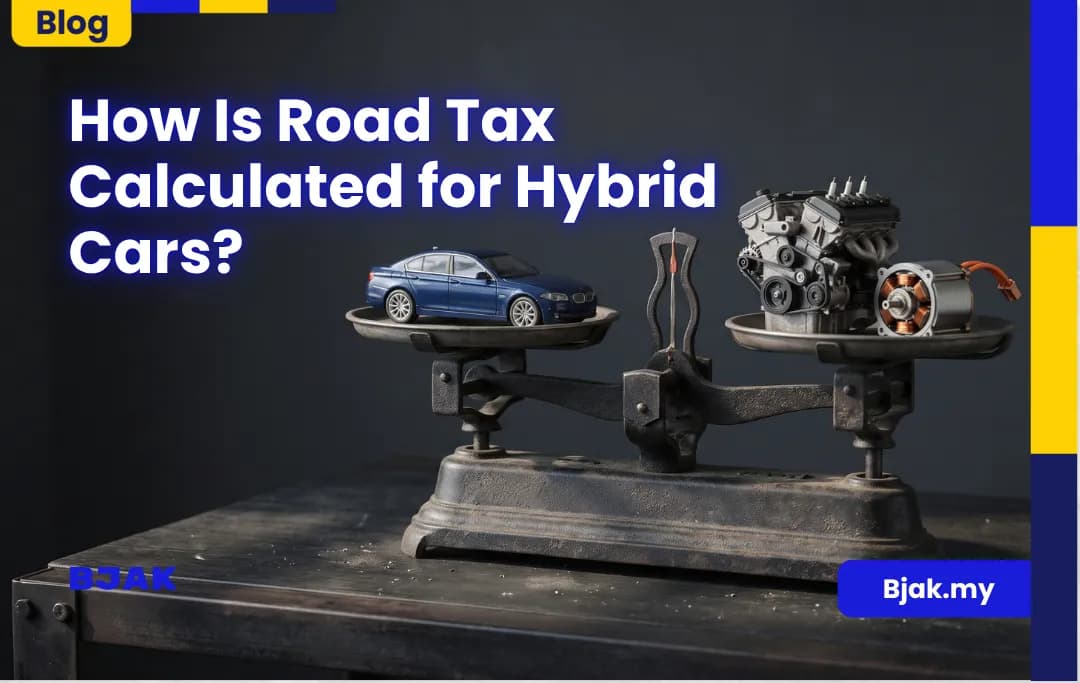
Hybrid cars combine a petrol or diesel engine with an electric motor. However, having an electric motor does not mean they follow the same road tax calculation as fully electric vehicles (EVs).
In Malaysia, road tax for most hybrid cars is calculated based on the capacity of the combustion engine, measured in cubic centimetres (cc). The electric motor’s power and the battery capacity are not added to the engine capacity when working out the usual hybrid road tax.
The amount you pay also depends on your vehicle type, registration location and ownership category.
How is road tax calculated for hybrid cars in Malaysia?
Most hybrid cars use the standard road tax schedule for vehicles with petrol or diesel engines. JPJ uses the engine capacity recorded for the vehicle to determine the applicable rate.
For example, a hybrid car with a 1,498cc petrol engine is generally calculated using the 1,401cc to 1,600cc road tax band. Its electric motor does not increase the engine capacity used in this calculation.
The same principle generally applies to different hybrid systems, including:
Mild hybrid (MHEV): Uses a small electric motor to assist the combustion engine.
Full hybrid (HEV): Can use the electric motor alone for short periods or combine it with the engine.
Plug-in hybrid (PHEV): Has a rechargeable battery that can be charged externally and can travel a certain distance using electric power.
Although their battery sizes and electric driving ranges differ, these systems do not automatically qualify for the fully electric vehicle road tax schedule. Check the vehicle’s registration details and applicable JPJ classification if you are unsure.
What factors affect hybrid car road tax?
Your hybrid’s engine capacity is important, but it is not the only factor. The amount also depends on the following details.
1. Engine capacity (cc)
A larger combustion engine usually means higher road tax. The rate structure also changes above 1,600cc.
For privately registered saloon cars in Peninsular Malaysia, the 2026 rates are:
Engine capacity
Annual road tax
1,000cc and below
RM20
1,001cc–1,200cc
RM55
1,201cc–1,400cc
RM70
1,401cc–1,600cc
RM90
1,601cc–1,800cc
RM200 + RM0.40 per cc above 1,600cc
1,801cc–2,000cc
RM280 + RM0.50 per cc above 1,800cc
2,001cc–2,500cc
RM380 + RM1.00 per cc above 2,000cc
For engines above 2,500cc, higher progressive rates apply. These figures are for private saloon cars, not every vehicle category.
2. Vehicle body type
Road tax is not always the same for two cars with identical engine capacity.
In Malaysia, private saloon cars generally use a different rate schedule from non-saloon vehicles, including SUVs and MPVs.
For example, a 1,798cc engine in a private saloon car in Peninsular Malaysia works out to RM279.20 a year. A non-saloon vehicle with the same engine capacity has a different rate.
This is why you should check whether JPJ classifies your hybrid as a saloon or non-saloon vehicle before estimating its road tax.
3. Registration location
Road tax rates also differ by region.
For example, a privately registered saloon car with an engine capacity between 1,401cc and 1,600cc pays RM90 annually in Peninsular Malaysia, compared with RM72 in Sabah and Sarawak.
If your vehicle is registered or kept in a different region, check the applicable JPJ rate rather than using the Peninsular Malaysia table.
4. Ownership category
The registration category can also affect the amount. For example, privately registered and company-registered saloon cars may have different road tax rates.
Therefore, the engine capacity alone may not be enough to determine your exact annual payment.
How to calculate hybrid car road tax: Examples
Here are two examples using the 2026 rates for private vehicles in Peninsular Malaysia.
Example 1: A 1,498cc hybrid saloon
A hybrid saloon with a 1,498cc engine falls within the 1,401cc to 1,600cc band.
Engine capacity: 1,498cc
Applicable rate: RM90
Annual road tax: RM90
Example 2: A 1,798cc hybrid saloon
A 1,798cc engine falls within the 1,601cc to 1,800cc band. The rate includes a base amount and a progressive charge.
Base rate: RM200
Extra engine capacity: 1,798cc − 1,600cc = 198cc
Progressive charge: 198 × RM0.40 = RM79.20
Annual road tax: RM279.20
These examples are for private saloon cars. If the hybrid is registered as an SUV or another non-saloon vehicle, the applicable amount will differ.
Do hybrid and plug-in hybrid cars follow the 2026 EV road tax rates?
No, not simply because they have an electric motor or rechargeable battery.
From 1 January 2026, fully electric vehicles covered by the revised JPJ schedule are charged road tax based on electric motor power, measured in kilowatts (kW). This is different from the usual engine-capacity calculation for petrol, diesel and hybrid vehicles.
The difference is:
Vehicle type
Usual road tax calculation
Petrol or diesel car
Engine capacity (cc)
Hybrid (HEV or MHEV)
Combustion engine capacity (cc)
Plug-in hybrid (PHEV)
Generally based on its combustion engine capacity; check its JPJ classification
Fully electric vehicle (EV)
Electric motor power (kW), under the applicable 2026 schedule
Remember that kW and kWh measure different things. Kilowatts measure motor power, while kilowatt-hours measure battery energy capacity. The 2026 EV road tax schedule uses motor power, not battery capacity.
A hybrid can help reduce fuel consumption, but it does not automatically mean lower road tax. Before buying one, check its engine capacity, vehicle category and registration region so you can estimate the annual cost accurately.
You can also compare car insurance options on BJAK to understand another important part of your vehicle ownership costs.
Is hybrid car road tax cheaper than petrol car road tax?
Not necessarily. Both generally use engine capacity to determine road tax. A hybrid may pay the same amount as a petrol car with the same engine capacity, vehicle category, registration region and ownership category.
Does a hybrid car's electric motor affect its road tax?
Generally, no. The usual calculation is based on the combustion engine’s capacity, not the combined power of the engine and electric motor.
Do plug-in hybrid cars pay EV road tax?
Not automatically. A plug-in hybrid still has a combustion engine, so it generally follows the engine-capacity calculation. Check its JPJ registration classification for confirmation.
Is hybrid road tax cheaper in Sabah and Sarawak?
Generally, yes. Sabah and Sarawak have different, lower road tax rates for many vehicle categories compared with Peninsular Malaysia. The exact amount depends on the vehicle’s engine capacity and classification.
Does a hybrid SUV pay the same road tax as a hybrid sedan?
Not necessarily. SUVs and other non-saloon vehicles use a different rate schedule from private saloon cars. Check the vehicle’s registration category before estimating the amount.

 Nabil Farhan· · 5 min read