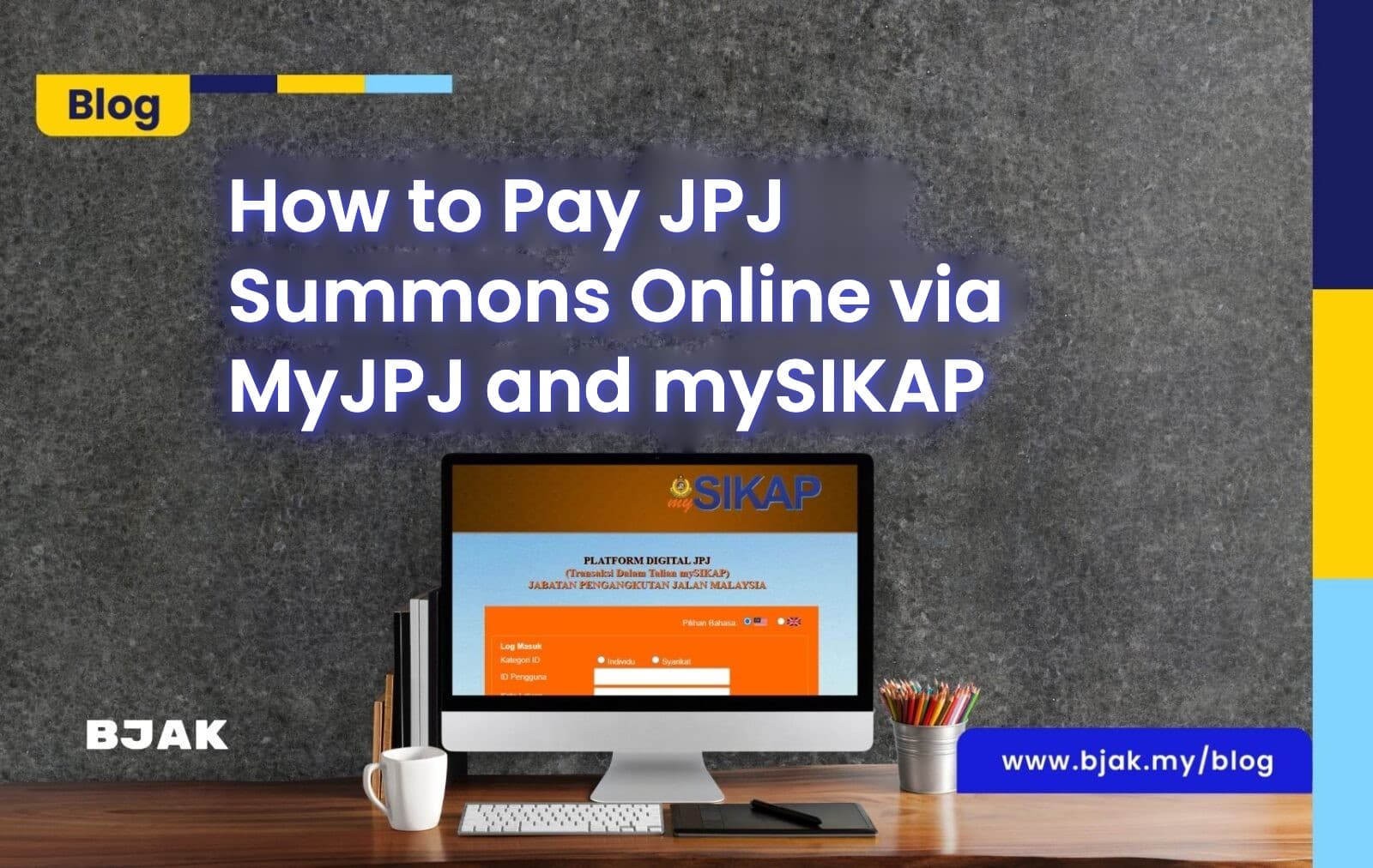
Got a JPJ summons that you have not settled yet? You no longer need to queue at a JPJ counter to pay it. If the offence can be compounded, you can check and pay the summons online through the MyJPJ app or the mySIKAP public portal, both run by the Road Transport Department (JPJ).
There is a catch, though. Not every summons can be paid online, and the amount you pay now depends on how quickly you settle it. This guide walks you through both payment channels, explains which summonses must be handled another way, and covers what to do once you have paid.
Before You Pay: Check Your Summons First
Start by confirming what you actually owe. Log in to MyJPJ or mySIKAP with your MyKad details and look at the summonses listed under your name. Each one shows the offence, the summons number and the amount payable at that moment.
JPJ summonses and police (PDRM) summonses sit on separate systems. A summons issued by the police will not appear in MyJPJ, so check both if you are unsure who issued it. Our guide on how to check JPJ summons online explains where to look for each type.
Method 1: Pay Through the MyJPJ App
MyJPJ is JPJ’s official mobile app. Besides your digital driving licence and road tax, it lets you view your active JPJ summonses and pay the ones that qualify. Here is how to pay:
Download MyJPJ from the Google Play Store or Apple App Store, then log in to your account.
Open the summons section (“Saman”) from the main menu.
Review the active summonses listed under your MyKad number.
Select the summons you want to settle and check the amount shown.
Choose one of the payment methods offered on screen and complete the transaction.
Save or screenshot the receipt for your records.
If you are new to the app, our step-by-step guide on how to use the MyJPJ app covers registration and the main features.
Method 2: Pay Through the mySIKAP Portal
Prefer a laptop or desktop? The mySIKAP public portal is JPJ’s web-based channel for online transactions, including summons enquiries and payment. The steps are similar:
Log in with your user ID and password, or register if you do not have an account.
Open the section for summonses or payments.
Check the summonses listed and select the one you want to settle.
Follow the payment instructions on screen and keep the receipt.
mySIKAP is also useful if you want a fuller record of your summons history, since the MyJPJ app focuses on summonses that are still active.
MyJPJ vs mySIKAP at a Glance
Feature
MyJPJ app
mySIKAP portal
Device
Smartphone
Laptop, desktop or mobile browser
Shows active JPJ summonses
Yes
Yes
Summons history
Limited to active summonses
Fuller record
Pay compoundable summonses
Yes
Yes
Other features
Digital road tax and driving licence
Wider range of JPJ online services
Summonses You Cannot Pay Online
This is the part many drivers miss. Online payment only works for offences that can be settled by paying a compound, which is a fine offered in place of court action. According to JPJ, the following cannot be paid through MyJPJ:
Non-compoundable offences, such as driving without motor insurance or a valid licence, or displaying a fake road tax. These must be settled in court.
Summons notices that require you to go to court, such as Notis Saman (114).
A notice to attend (“notis hadir”), which requires you to appear at the JPJ office to complete the investigation.
If you ignore a notice to attend, you can be blacklisted, and you will still need to go to JPJ in person to settle it. These points were confirmed by the JPJ Director-General in March 2026, as reported by Paul Tan.
Can You Pay a Blacklisted Summons Online?
In many cases, yes. Since 18 March 2026, drivers who were blacklisted because of AwAS (automated speed and red-light camera) summonses can pay them through MyJPJ. JPJ says the blacklist is lifted automatically in its system once the payment goes through, so you can renew your road tax without visiting a counter.
The same limits still apply. A blacklisted summons that involves a non-compoundable offence, or one that has gone to court, cannot be cleared in the app. If the app does not let you pay, contact JPJ or visit the nearest JPJ office for advice.
Pay Early to Pay Less
Since 1 January 2026, JPJ and PDRM use a single early payment scheme instead of the old festive discount campaigns. The faster you pay a compoundable summons, the less you pay, as reported by Free Malaysia Today.
When you pay
Discount
Day 1 to day 15
50%
Day 16 to day 30
33%
Day 31 to day 60
No discount
After day 60
No discount, and the case may go to court or lead to blacklisting
The discount is applied automatically in the system, so the amount shown when you log in is the amount you pay. Non-compoundable offences do not get any discount.
What to Do After Paying
Keep the receipt or transaction record until the summons disappears from your list.
If the payment shows as pending, wait a while and check your transaction history before trying again, so you do not pay twice.
Allow a little time for the status to update. Payments through official channels usually reflect within a few working days.
If the problem persists, contact JPJ through the support channels listed on its official website.
Will an Unpaid Summons Stop Your Road Tax Renewal?
Not every unpaid summons blocks a renewal. What matters is whether you or your vehicle has been blacklisted. Once a summons is left unpaid long enough to trigger a blacklist, you cannot renew your road tax or driving licence until it is settled.
Paying a JPJ summons online is quick when the offence is compoundable. Use the MyJPJ app on your phone or the mySIKAP portal on your computer, check the amount shown, pay, and keep your receipt.
Before you pay, make sure the summons is still active, that it can be compounded and whether you are still within the 15-day or 30-day discount window. Pay early and you will save money and avoid a blacklist when your road tax is due.
Log in to the MyJPJ app or the mySIKAP public portal, open the summons section, select the summons you want to settle and complete the payment using one of the methods shown. Keep the receipt after the transaction.
Can all JPJ summonses be paid online?
No. Only compoundable summonses can be paid online. Non-compoundable offences, such as driving without insurance or a licence, and summonses that require a court appearance must be settled through the process stated on the notice.
Can I pay a blacklisted summons through MyJPJ?
Since 18 March 2026, blacklisted AwAS summonses can be paid through MyJPJ, and JPJ says the blacklist is lifted automatically once payment is successful. Non-compoundable or court cases still need to be settled in person or in court.
Is there a discount for paying a JPJ summons early?
Yes. Since 1 January 2026, compoundable JPJ and PDRM summonses get a 50% discount if paid within 15 days of issue and a 33% discount between day 16 and day 30. There is no discount after day 30.
Can I pay police (PDRM) summonses in MyJPJ?
No. MyJPJ and mySIKAP are for JPJ summonses. Police summonses are checked and paid through PDRM’s own channels, so check both if you are not sure who issued your summons.
Do I need to go to a JPJ counter at all?
Usually not for compoundable summonses. You only need to visit JPJ if the summons cannot be paid online, if you received a notice to attend, or if the app does not allow the payment.

 Nabil Farhan· · 6 min read